 DecoyStack
Put decoys where attackers look. Know when they’re touched.
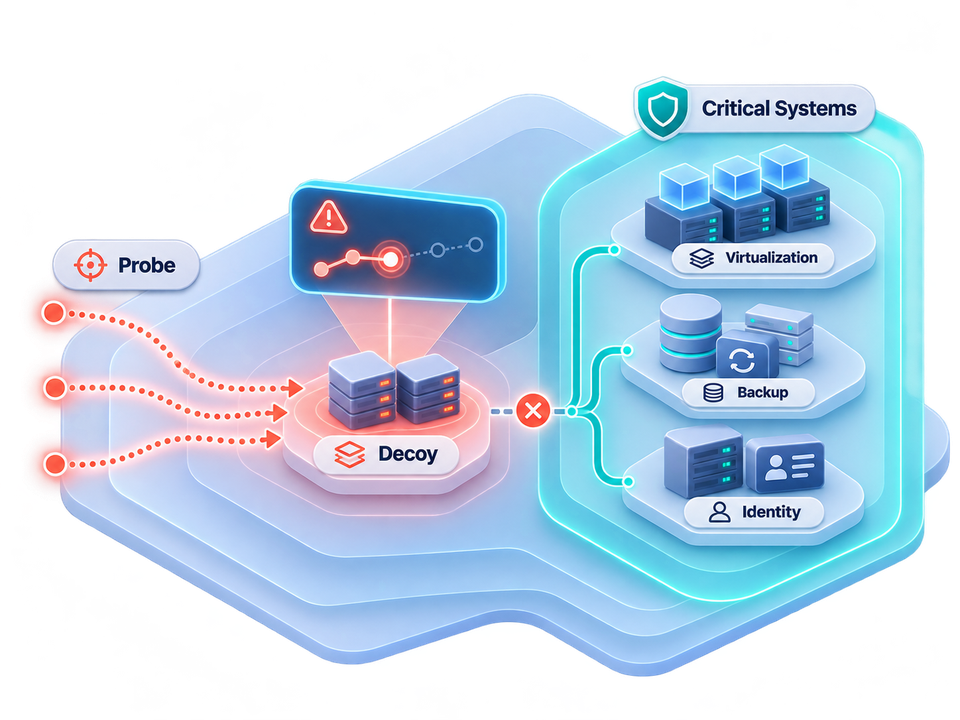
Attackers look for backup servers, hypervisors, domain services and management systems. DecoyStack creates purpose-built infrastructure decoys that give your security team a useful signal when someone interacts with them.
Unexpected decoy interaction
ReviewA designated virtualization decoy received an interaction from an internal source.
Unexpected infrastructure activity can hide in routine network traffic.
During an intrusion, attackers may look for virtualization platforms, backup systems, directory services and management interfaces. That activity can be difficult to distinguish from routine network traffic.
Make unexpected access stand out
A connection to a designated decoy gives your SOC a clear reason to investigate.
Watch the infrastructure that matters
Represent backup, virtualization, identity, server management and network-security technologies.
Give analysts useful context
See which decoy was contacted, where the interaction came from and which service was involved.
A clearer starting point for your next investigation.
Traditional monitoring provides essential visibility, but understanding why an interaction matters can require correlating several sources.
A connection was observed
Is it routine activity, authorized scanning or something that deserves investigation?
- Context may be distributed across several tools.
- The system’s role still has to be established.
- The analyst decides whether the activity matters.
A designated decoy was contacted
The event identifies the decoy, the source and the observed service.
vCenter profileInternal host identifiedHTTPS managementReview recommended23 infrastructure decoys backed by defined internal lab checks.
DecoyStack represents technologies commonly found in enterprise infrastructure through version-specific profiles.
Virtualization
VMware ESXi, VMware vCenter and Proxmox VE
Backup & Recovery
Veeam Backup & Replication
Identity Services
Windows Server Domain Controller
Server Management
Dell iDRAC, HPE iLO and Lenovo XClarity
Network Security
Palo Alto PAN-OS
Choose your decoys. Observe the activity. Use the signals.
Choose what to represent
Select infrastructure profiles that match the technologies you want to monitor.
Place your decoys
Run isolated decoy identities with separate network identities and defined exposure.
Investigate unexpected contact
Capture structured events and send them into your existing security workflow.
Supports JSONL, Syslog RFC 5424 and CEF event formats. These are standards-based event formats; DecoyStack does not claim certified vendor connectors.
A decoy should create evidence, not unnecessary exposure.
DecoyStack uses network isolation, restricted outbound communication and defined service behavior.
Separate identities
Decoy instances have individual network identities and operating boundaries.
Restricted communication
Outbound connections follow restrictive policies with explicit operational allowances.
Controlled exposure
Services expose selected protocol surfaces rather than unrestricted host access.
Technical details and operating limits
Help shape a better way to detect unexpected infrastructure activity.
We’re looking to speak with SOC teams, security leaders, MSSPs and infrastructure specialists interested in how DecoyStack could fit their security operations.
- Infrastructure deception use cases
- Decoy placement and security requirements
- Event collection and SOC workflows
- Requirements for a potential future controlled evaluation
Contact Engineering
Submit your evaluation context. Our engineering team reviews each inquiry directly.